Facioscapulohumeral Muscular Dystrophy (FSHD)
Facioscapulohumeral Muscular Dystrophy (FSHD) is a progressive, genetic neurological condition. It is a type of muscular dystrophy affecting skeletal muscles.
In most cases, FSHD is inherited and is commonly passed down through generations.
There are two types of FSHD; FSHD1 (95% of cases) and FSHD2 (less common, more complex genetics). 1 in every 7,500 individuals are estimated to have FSHD.
FSHD does not follow a standard pattern of presentation and progression. Approximately 20% of people with FSHD will require a wheelchair.
Typically, FSHD does not shorten a persons life expectancy
Typical symptoms can but don’t always include:
Inability to pucker the lips e.g. to blow a balloon or to whistle.
Inability or difficulty to sip through a straw.
Eyes that don’t close fully during sleep.
Difficulty with sit-ups and pull-ups.
Scapular winging
Difficulty raising arms above shoulder height.
Weakness in hands and fingers.
Foot drop
Weak lower abdominal muscles, pec muscles
Sunken breastbone (pectus excavatum).
Curved spine (lordosis, kyphosis, scoliosis).
Chronic fatigue.
Pain, often severe (reported in 70% of patients).
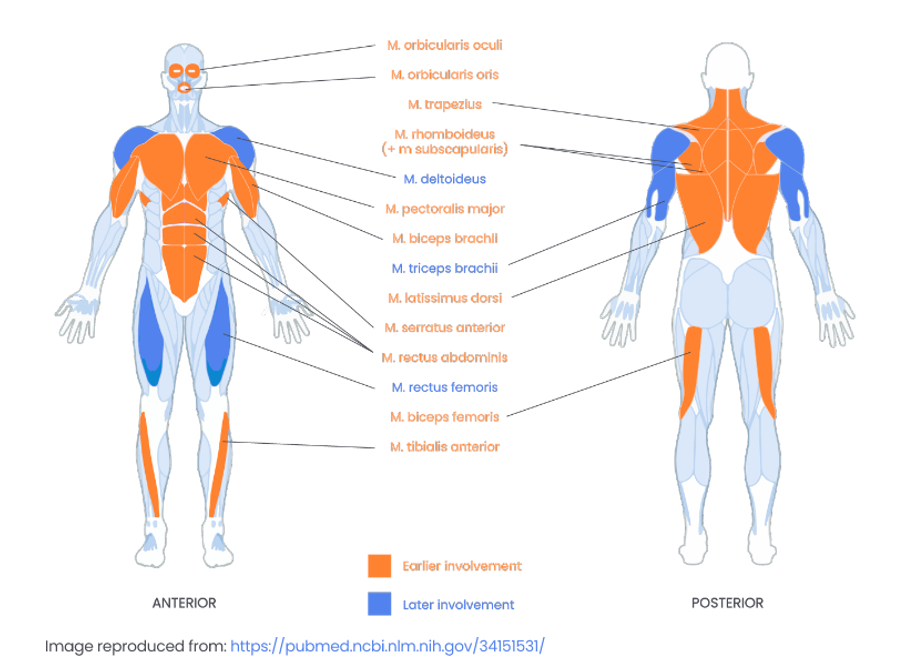
Muscle weakness typically develops asymmetrically with the common affected muscles demonstrated in this diagram. >
What are the functional implications?
Difficulty with reaching overhead, grooming, lifting
Fatigue with ambulation and transfers
Risk of falls (esp. with trunk/leg weakness)
Facial weakness impacts communication and eating
May impact employment, ADLs, and community access
FSHD can affect all aspects of daily life, limiting personal independence and mobility.
How can Neuro Junction assist with the management of FSHD:
For optimal management of FSHD there needs to be a multidisciplinary approach – including physiotherapists and occupational therapists.
Some examples of how our physiotherapists can assist:
Postural control and scapular stability
Core strengthening (avoid overload)
Gentle aerobic conditioning, Energy conservation
Falls prevention strategies
Support orthotic use (AFOs, lumbar supports, UL supports)
Hydrotherapy
Massage
Mobility aids
Some examples of how our occupational therapists can assist
Assistance with ADLs (dressing, grooming, bathing)
Equipment provision (e.g. shower chairs, grab rails, wheelchairs
Environmental adaptations
Fatigue management and activity pacing
Support for employment and community participation
Further Support for those with FSHD:
FSHD Global – Research Foundation - https://fshdglobal.org/what-is-fshd/support-available-for-australians-living-with-fshd/
Muscular Dystrophy Australia - https://www.mda.org.au/
https://mdqld.org.au/ (muscular dystrophy QLD)
https://mdnsw.org.au/ (muscular dystrophy NSW)
The loop https://theloopcommunity.org/
A space created by Muscular Dystrophy Foundation Australia, is where you can prepare and share steps and stages of life, and find your voice alongside others